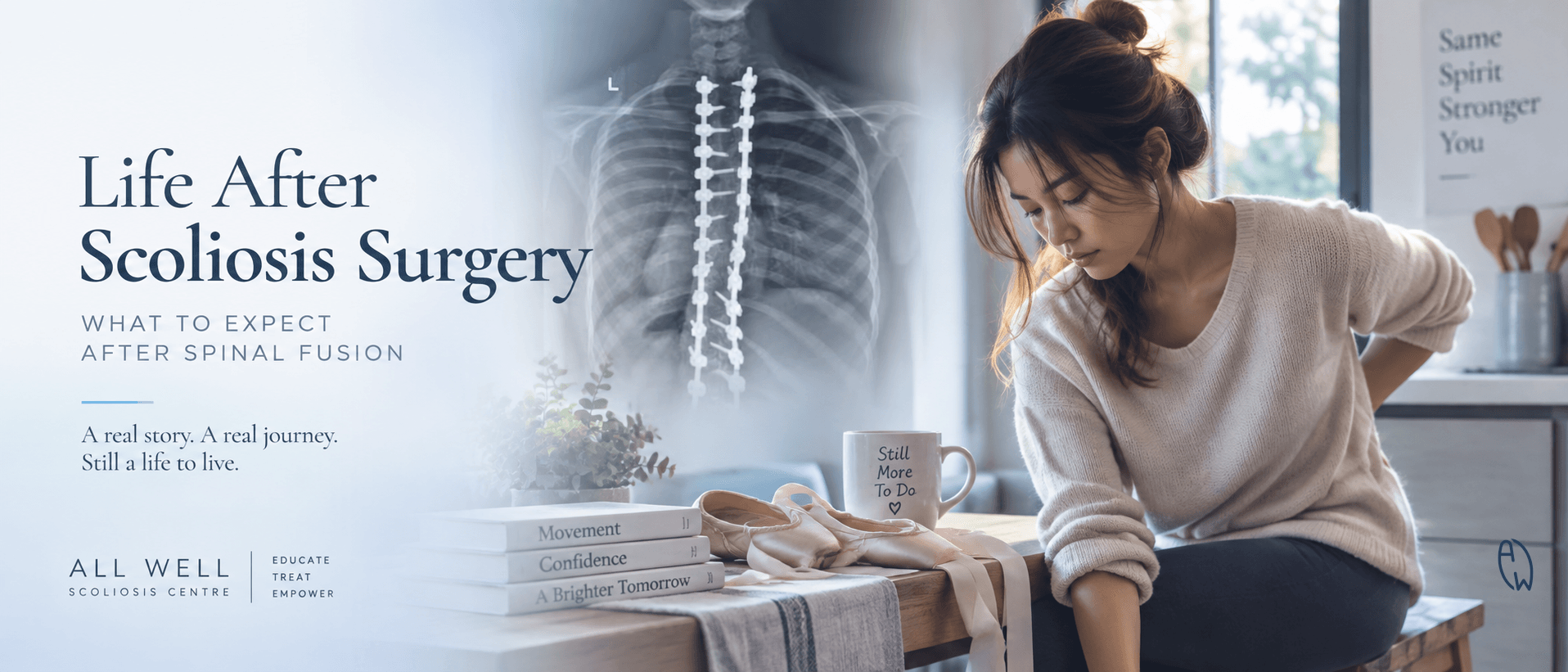
Life After Scoliosis Surgery: What to Expect After Spinal Fusion
“I Thought Surgery Would End My Pain. I Didn’t Realize How Much My Life Would Change.”
When you are told that your scoliosis is getting worse, it can be frightening.
You look at the X-ray.
You hear the Cobb angle.
You hear words like progression, deformity, lung function, and eventually, surgery.
For many patients and parents, the decision can feel like a race against time.
“We need to stop this before it gets worse.”
For some people with severe or progressive scoliosis, spinal fusion can be an appropriate treatment. Surgery can correct a significant portion of the spinal deformity and is designed to prevent progression of the fused curve.
But there is another part of the conversation that deserves just as much attention:
What happens after the surgery?
Not just during the operation.
Not just when the X-ray looks straighter.
But years later—when you are exercising, travelling, cooking dinner, getting out of bed, bending down, dancing, or simply trying to live your normal life.
This is where Adele’s story begins.
Adele Had the Surgery She Thought She Needed
Adele underwent scoliosis surgery on her 21st birthday.
Her curve had been progressing, and she was frightened about what might happen if she left it untreated.
She had been told that the curve could eventually affect her organs, including her breathing and digestion.
At 21, those possibilities were frightening.
She did not want to wait and find out.
So she agreed to surgery.
The operation itself went well.
Modern spinal surgery has become increasingly sophisticated. Technologies such as computer-assisted navigation and robotic assistance can help surgeons plan procedures and place instrumentation with greater precision.
Her curve was corrected.
Her spine was stabilized.
From the outside, it looked like the problem had been addressed.
But recovery introduced a side of scoliosis surgery she had not fully understood before the operation.
Her spine moved differently.
What Life Was Like After Scoliosis Surgery
Recovery was not simply about waiting for an incision to heal.
Adele had to learn how to live with a spine that had been surgically altered.
Years later, she described her experience:
“I didn’t realize how heavy my back would feel. I can’t bend down easily. My neck gets tired really fast. My hips always ache, and lying down is always the best option.”
Then she said something that stayed with us:
“I can’t dance anymore.”
It was not only about dancing.
Things that once seemed completely ordinary—baking, cooking, bending down, moving around the kitchen—had become more difficult.
These are not dramatic medical emergencies.
They are everyday movements.
And sometimes, everyday movements tell you more about someone's quality of life than an X-ray ever can.
Adele’s experience is her own. It does not mean every person who undergoes scoliosis surgery will experience the same symptoms or limitations.
Many patients have meaningful improvements after surgery.
But her story raises an important question:
When we talk about scoliosis surgery, are we talking enough about life after the operation?
“I Didn’t Expect My Back to Feel This Different”
Scoliosis surgery has a clear mechanical objective.
During spinal fusion, the surgeon corrects the spinal deformity and uses instrumentation such as screws and rods to hold the spine in its corrected position while the vertebrae fuse.
The resulting fused section is intentionally more stable—and less mobile.
That stability can be extremely valuable.
But stability and mobility are not the same thing.
When part of the spine is fused, that portion no longer moves in the same way as a normal spinal segment. Movement therefore has to come from the parts of the spine that remain mobile, as well as the surrounding muscles and joints.
For some people, this may have little impact on everyday life.
For others, the difference can become noticeable.
Bending.
Twisting.
Reaching.
Dancing.
Exercising.
Getting comfortable in bed.
These are movements most of us never think about until they become difficult.
That is why scoliosis treatment should be evaluated not only by how straight the spine looks, but also by how well the person functions.
If you are experiencing new or changing pain with scoliosis, read our guide, Why Does My Scoliosis Hurt Now When It Never Hurt Before?.
What Does Spinal Fusion Change?
Spinal fusion is designed to create a stable section of the spine.
The surgeon corrects the deformity and uses instrumentation to maintain that correction while the vertebrae fuse together.
The Scoliosis Research Society describes spinal fusion as an established surgical treatment for appropriately selected patients with significant scoliosis. Surgical goals can include correcting the deformity, improving alignment and preventing further progression of the fused curve.
But a fused spine is not simply a straighter version of the original spine.
It is a different mechanical system.
The sections that remain mobile continue to move.
The muscles surrounding the spine continue to work.
The hips and pelvis continue to contribute to movement.
The nervous system continues to coordinate the entire body.
This is why looking only at the surgical correction can tell us only part of the story.
What Can Change Years After Spinal Fusion?
It is important not to assume that every symptom after surgery is caused by the fusion.
Pain, stiffness, muscular fatigue and movement limitations can have many contributing factors.
Scoliosis itself affects the body's biomechanics. Postoperative symptoms can also be influenced by the original deformity, the extent of surgery, rehabilitation, physical conditioning and other individual factors.
However, long-term considerations after fusion are recognized in the medical literature.
The Scoliosis Research Society discusses postoperative issues including stiffness, post-surgical malalignment and changes affecting spinal segments adjacent to a fusion.
Research into adjacent-segment degeneration also suggests that the issue is complex. Degenerative changes can occur naturally with age, making it difficult to attribute every change next to a fusion directly to the surgery itself.
That distinction matters.
Because the purpose of this conversation is not to frighten people away from surgery.
It is to help people understand what they are choosing.
For a broader discussion of how scoliosis can change over time, read Can Scoliosis Get Worse With Age? and Will My Scoliosis Get Worse?.
What I Wish I Had Known Before Scoliosis Surgery
Perhaps the most important part of Adele’s story is not that she had surgery.
It is what she wishes she had understood beforehand.
If she could speak to her 21-year-old self today, she would not necessarily say:
“Don’t have surgery.”
She would say:
“Ask more questions.”
What exactly will be fused?
A spinal fusion can involve different numbers of vertebrae depending on the curve and surgical plan. The extent and location of the fusion can influence the amount of movement remaining.
How much mobility will I have afterwards?
The answer depends on the levels fused and the individual.
It is worth discussing how surgery may affect the activities that matter most to you.
If movement, exercise or athletic performance is important to you, make those goals part of the conversation before surgery.
What will recovery really look like?
Recovery extends beyond the operation itself.
Rehabilitation, gradual strengthening and returning to activities are important parts of the process.
What are the potential long-term considerations?
Ask about complications, instrumentation problems, adjacent spinal segments, alignment and the possibility of further treatment.
What happens if I wait?
If surgery is recommended, understand what your medical team expects could happen if you delay treatment.
Ask what would be monitored and what changes might make surgery more urgent.
Our article Will My Scoliosis Get Worse? explores some of the factors that can influence scoliosis progression.
Are there appropriate non-surgical options for my particular situation?
Not every curve can or should be managed without surgery.
But for some patients, there may be reasonable non-surgical approaches worth exploring before an irreversible procedure.
Getting a second opinion can help you understand those options more clearly.
Adele Wasn't Looking for Another Surgery
When Adele eventually came to All Well Scoliosis Centre, she was not looking for a way to reverse her fusion.
She understood that her spine had been surgically altered.
What she wanted was much more practical.
She wanted to feel like herself again.
She wanted to become stronger.
She wanted to move better. Less stiff.
She wanted to feel less pain.
She wanted to feel less migrain.
She wanted to understand why her neck and hips were working so hard.
She wanted to feel more confident in her body.
And she wanted to know:
“Is there anything I can still do?”
We believe that is an important question—whether someone has had surgery or not.
Life After Surgery Still Needs Care
Having scoliosis surgery does not mean that the scoliosis journey is over.
In many ways, the focus simply changes.
Before surgery, the priority may be preventing progression and determining whether surgical intervention is appropriate.
After surgery, the focus may shift toward helping the body function as well as possible within its new mechanical reality.
That can include:
-
Building and maintaining strength
-
Improving movement quality
-
Maintaining mobility in the areas that can still move
-
Developing better body awareness
-
Improving balance and coordination
-
Managing muscular tension
-
Maintaining cardiovascular fitness
-
Supporting healthy muscles and bones
-
Understanding how the body compensates for the fused segments
The goal is not to “unfuse” the spine.
It is to help the rest of the body move and function as efficiently as possible around it.
For more on scoliosis-specific rehabilitation, read Scoliosis-Specific Exercises (PSSE): Evidence-Based Rehabilitation for Scoliosis.
What About Non-Surgical Scoliosis Treatment?
For some patients, non-surgical care may have an important role.
The appropriate approach depends on the individual's age, skeletal maturity, curve pattern, progression, symptoms, spinal balance and treatment goals.
Non-surgical care cannot replace surgery when surgery is genuinely medically necessary.
But there are patients for whom the priority may be to manage symptoms, maintain function, improve strength or attempt to control progression before surgery becomes necessary.
Our article Can Scoliosis Be Corrected Without Surgery? explores what non-surgical scoliosis treatment can realistically aim to achieve.
At All Well Scoliosis Centre, our philosophy is simple:
We want to help people improve and preserve function wherever possible.
Our approach may include several components depending on the individual.
CLEAR® Protocol
The CLEAR approach combines specific chiropractic care with corrective exercises and neuromuscular retraining, with an emphasis on spinal biomechanics.
ScoliBrace®
ScoliBrace is a custom-designed three-dimensional corrective brace used for appropriately selected patients. The brace is designed around the individual's spinal pattern rather than using a one-size-fits-all approach.
ScoliBalance®
ScoliBalance® is a scoliosis-specific exercise approach focusing on posture, movement, muscular control and functional integration.
Strength and Movement
Because scoliosis is not simply a problem of bones.
The muscles, nervous system, balance, breathing mechanics and movement patterns all contribute to how a person experiences their body.
For adults with scoliosis, Can I Exercise With Scoliosis? provides a more detailed discussion of exercise, strength training and movement.
The Goal Is More Than a Smaller Cobb Angle
The Cobb angle is an important measurement.
But a person is not a number on an X-ray.
Two people with similar Cobb angles can have completely different experiences.
One may have little pain and excellent function.
Another may struggle with stiffness, weakness, balance or everyday movement.
That is why we believe scoliosis care should look beyond the curve itself.
We want to understand:
How does this person move?
How strong are they?
How well do they balance?
How does their body compensate for the curve?
What activities matter to them?
And perhaps most importantly:
What can we do to help preserve or improve function for as long as possible?
This is also why our approach to scoliosis includes more than the spine itself.
If you want to understand more about the relationship between scoliosis and balance, read Why Do Some People With Scoliosis Have Poor Balance?.
Surgery Is Not the Enemy. An Informed Decision Matters.
This is an important distinction.
We are not anti-surgery.
For some patients with severe or progressive scoliosis, surgery may be an appropriate and valuable treatment.
And we are not suggesting that non-surgical care can replace surgery in every case.
Our position is simpler:
People deserve to understand their options before making an irreversible decision.
They deserve to understand what surgery can achieve.
They deserve to understand what spinal fusion changes.
They deserve to know what recovery may involve.
And they deserve to know whether there are appropriate alternatives worth exploring first.
The decision should ultimately be made between the patient, family and qualified healthcare professionals based on the individual's circumstances.
Adele's Story Is About More Than Surgery
Adele's experience reminded us of something that can easily get lost when scoliosis is discussed primarily through X-rays and Cobb angles.
Sometimes we focus so intensely on stopping the curve that we forget to ask about the life that comes afterwards.
Her surgery may have achieved its intended surgical goals.
But years later, she was still searching for ways to feel comfortable and capable in her body.
And that is where scoliosis care should continue.
Not at the end of the operating table.
But in everyday life.
At All Well Scoliosis Centre, we believe patients should feel informed, empowered and supported—not pressured.
If surgery is appropriate, patients should understand why.
If non-surgical care is appropriate, they should know that too.
And if surgery has already happened, we believe the journey does not end there.
There is still strength to build.
There is still movement to explore.
There is still function to preserve.
There is still confidence to regain.
There is still a life to live.
Because scoliosis treatment isn't ultimately about creating the perfect X-ray.
It's about helping a person live as well as possible in the body they have.
Frequently Asked Questions
Can you live a normal life after scoliosis surgery?
Many people return to active and fulfilling lives after scoliosis surgery. However, recovery and long-term mobility vary depending on factors such as the extent and location of the fusion, individual health, rehabilitation and the activities a person wants to perform.
Does spinal fusion permanently reduce mobility?
The fused portion of the spine is intentionally made rigid, so that section no longer moves normally. The amount of overall mobility a person experiences afterward depends on the levels fused and the mobility of the remaining spinal segments.
Can you exercise after scoliosis surgery?
Many people can return to exercise after recovering from scoliosis surgery. The timing and type of activity should be discussed with the treating medical team.
Maintaining appropriate strength and physical activity can remain important after fusion. For more information, see Can I Exercise With Scoliosis?.
Are there alternatives to scoliosis surgery?
Depending on the patient's age, curve, progression, symptoms and other factors, non-surgical approaches such as observation, scoliosis-specific exercise and bracing may be appropriate.
However, non-surgical treatment is not a substitute for surgery in every situation.
Read more in Can Scoliosis Be Corrected Without Surgery?.
Can scoliosis come back after spinal fusion?
The fused portion of the spine is intended to prevent progression of the treated curve, but changes can still occur in other parts of the spine. Long-term follow-up may therefore remain important after surgery.
What should I ask before scoliosis surgery?
Patients may want to ask why surgery is recommended, how many levels will be fused, what mobility may remain, what recovery involves, what complications are possible, and whether appropriate non-surgical options should be considered.
Can non-surgical treatment help after scoliosis surgery?
Non-surgical care cannot reverse a spinal fusion.
However, appropriately selected rehabilitation, exercise, strength training and movement-focused care may help some people improve or maintain function after surgery.
The appropriate approach depends on the individual's surgical history and current condition.
Medical References
-
Scoliosis Research Society — Scoliosis Surgery
Scoliosis Research Society: Surgery
Covers indications for surgery, spinal fusion, instrumentation, expected recovery and treatment goals.
-
Scoliosis Research Society — Post-Surgical Malalignment
Scoliosis Research Society: Post-Surgical Malalignment
Discusses post-fusion issues including flat-back syndrome, junctional kyphosis and adjacent-level disease.
-
Scoliosis Research Society — Patient Information on Surgery and Treatment
Scoliosis Research Society Patient Resources
Useful as the broader patient-facing reference for scoliosis diagnosis and treatment.
-
European Spine Journal — Readmission Rate Following Surgical Treatment for Spinal Deformity: A Systematic Review and Meta-analysis (2026)
European Spine Journal: Readmission Rate Following Surgical Treatment for Spinal Deformity
A recent systematic review and meta-analysis examining postoperative readmission and reoperation following spinal deformity surgery.
-
European Spine Journal — Long-term Follow-up of Non-neurologic and Neurologic Complications After Complex Adult Spinal Deformity Surgery
European Spine Journal: Long-term Complications After Adult Spinal Deformity Surgery
Particularly relevant to your article because it examines complications and reoperations occurring 2–5 years after surgery in a complex adult spinal deformity population.