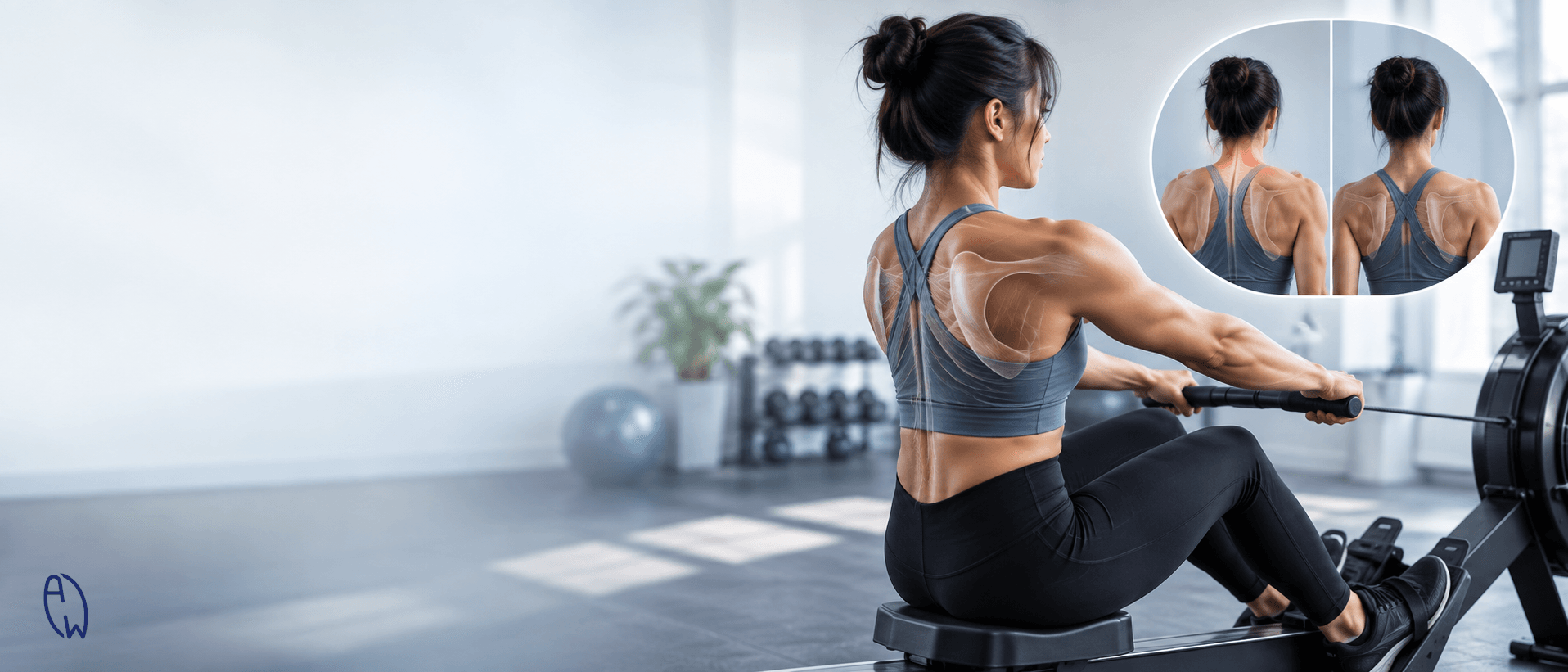
Why Do You Struggle With Rowing Even If You're Strong? Your Upper Back May Be the Problem
You can deadlift 100 kg.
You can squat heavy.
You can carry impressive weights.
You are strong.
But put you on a rowing machine and suddenly everything feels awkward.
Your neck gets tight.
Your shoulders creep toward your ears.
Your arms seem to do all the work.
Your upper back feels stiff.
And when the instructor says:
“Move your back in and out.”
Or:
“Keep your shoulders down.”
Or:
“Squeeze your shoulder blades together.”
You may think:
“What am I actually supposed to do?”
This is surprisingly common.
And it doesn't necessarily mean you need to become stronger.
Sometimes, you are already strong enough. Your problem is that your upper back and shoulder blades don't move—or aren't being controlled—the way they need to during rowing.
Why Is Rowing So Hard When You're Strong?
Rowing isn't simply an exercise for your arms and back.
It is a coordinated movement involving your:
-
Thoracic spine
-
Rib cage
-
Shoulder blades
-
Shoulder joints
-
Arms
-
Trunk
-
Neck
Your ability to produce force is only one part of the equation.
You also need to be able to move that force through your body efficiently.
Think about a car.
Having a powerful engine doesn't automatically mean the car handles well.
Your muscles are your engine.
Your mobility and coordination help determine how well that engine can be used.
This is why someone who can lift 100 kg may still struggle with rowing.
They have the strength—but they may not have enough movement or awareness to use that strength efficiently.
This is also why we often talk about posture as something more than simply “standing straight.” At All Well, we believe the ability to move in and out of positions with control is an important part of healthy movement. Read more in our article, Posture Reset: Why Movement Matters More Than “Good Posture”.
Can a Stiff Upper Back Affect Rowing Technique?
Your thoracic spine is the part of your spine that runs through your upper and middle back.
It sits between your neck and lower back and works closely with your ribs and shoulder blades.
During rowing, your upper back isn't simply a rigid platform supporting your arms.
It is part of a moving system.
Your thoracic spine, rib cage and shoulder blades need to coordinate with your arms as you reach and pull.
When the upper back is stiff or you have difficulty controlling its movement, other areas may compensate.
You may then:
-
Pull harder with your arms
-
Shrug your shoulders
-
Overuse your neck
-
Brace excessively
-
Arch through your lower back
-
Pull your elbows too far behind you
-
Grip the handle too tightly
The exercise still gets done.
But it may not feel smooth.
And sometimes, the harder you try, the more tension you create.
This is why upper-back mobility is not just about flexibility. It is also about having enough controlled movement to allow the rest of the body to work together.
If your upper back feels persistently stiff or rounded, it may also be useful to understand the difference between simple stiffness and structural changes in the thoracic spine. See our guide to Hunchback Posture: Causes, Symptoms, Treatment & Why Stretching Alone Isn't Enough.
Why Do I Feel Rowing in My Neck Instead of My Back?
This is one of the most common complaints.
You start rowing and think:
“Why am I feeling this all the way up in my neck?”
It is tempting to conclude:
“My upper traps are too tight.”
But that's not necessarily what is happening.
Your upper trapezius muscles are not supposed to be completely switched off.
They are part of normal shoulder and scapular movement.
The more useful question is:
Can you control your shoulder blades without constantly shrugging or bracing through your neck?
If you struggle to control the movement of your scapulae, your body may rely on a movement strategy that feels familiar.
For some people, that means excessive neck or shoulder tension.
The answer isn't necessarily to force your shoulders downward.
It may be to first teach your body how the shoulder blades are supposed to move.
Your neck also does not exist in isolation from the rest of your body. Changes in upper-back movement, head position and overall posture can influence how the neck and shoulders are used. For more on this whole-body relationship, see our article on Reversal of Cervical Lordosis: The Hidden Link Between Neck Alignment, Posture, and Balance.
Your Shoulder Blades Are Supposed to Move
This is an important concept.
Your shoulder blade, or scapula, isn't fixed to your rib cage.
It sits on the back of your rib cage and is designed to glide and rotate across it.
Your scapulae can move:
-
Toward and away from your spine
-
Up and down
-
Rotate upward and downward
-
Tilt and adjust their position
This movement helps your arms and shoulders function properly.
So when someone tells you:
“Squeeze your shoulder blades together,”
that is only one part of the movement.
Your shoulder blades aren't supposed to stay squeezed together throughout an exercise.
They need to move.
They need to glide around the rib cage.
What Does “Squeeze Your Shoulder Blades Together” Actually Mean?
This is where exercise instructions can become confusing.
An instructor may say:
“Squeeze your shoulder blades together.”
But if nobody has taught you what that movement should feel like, you may simply pull your arms backward.
Or shrug.
Or arch your back.
Or tense your neck.
You might think you're following the instruction perfectly.
But you're actually using your arms and neck to create the movement.
This is why a cue can be technically correct but still not useful if you don't understand how the movement should feel.
Instead of thinking:
“Pull my shoulders back.”
Try thinking:
“Can I feel my shoulder blades moving across my rib cage?”
That is a very different experience.
Why “Shoulders Down” Can Sometimes Make You More Tense
Another common instruction is:
“Keep your shoulders down.”
The intention may be to prevent excessive shrugging.
But if you interpret this as:
“Push my shoulders down as hard as possible,”
you may create more tension rather than less.
Your shoulder blades aren't supposed to be pinned downward.
They need freedom to move.
The goal is not to eliminate movement.
The goal is to control movement.
Your upper traps don't need to disappear.
Your shoulder blades don't need to be glued down.
Your neck doesn't need to be rigid.
You need enough control to allow the right muscles and joints to participate in the movement.
Stiff Upper Back or Poor Body Awareness?
Sometimes the problem isn't simply stiffness.
You may have enough physical movement but have difficulty feeling and controlling it.
This is an important distinction.
Imagine someone telling you:
“Move your upper back.”
You may try—but you don't actually know what movement they're looking for.
Your body might move somewhere else instead.
You may extend your lower back.
You may pull your shoulders backward.
You may lift your chin.
You may tense your neck.
This is why mobility and movement awareness often need to work together.
Having movement available is one thing.
Knowing how to control it is another.
This is also where proprioception—your awareness of where your body is and how it is moving—becomes important.
You don't always need someone to tell you to move differently.
You need to learn how to recognize the movement yourself.
Our article Scoliosis May Not Be Just a Spine Story: The Hidden Role of Vision, Vestibular Function, and Proprioception explores this concept in greater depth, including how proprioception contributes to body awareness, balance and movement.
And if you're interested in the relationship between the brain, movement and spinal control, you can also read Scoliosis, Neuroplasticity and the Brain-Body Connection.
Try This Before Your Next Row: “Flap Your Wings”
One simple movement drill can help you explore scapular movement before loading your body with rowing.
I like to think of it as:
“Flap your wings.”
Use a light loop band around your forearms.
Keep the resistance light.
The goal is not to make your muscles burn.
The goal is to feel the shoulder blades moving.
How to do it
-
Stand or sit tall with your neck relaxed.
-
Place a light loop band around your forearms.
-
Keep your elbows comfortably bent.
-
Gently move your forearms apart against the band.
-
Allow your shoulder blades to move naturally around your rib cage.
-
Slowly return.
-
Repeat approximately 8–12 times.
-
Breathe normally throughout the movement.
Don't force your shoulders down.
Don't aggressively squeeze your shoulder blades together.
Don't stick your chest out.
And don't turn it into a heavy resistance exercise.
Instead, ask yourself:
Can I feel my shoulder blades moving?
Can I keep my neck relaxed?
Can I move my arms without shrugging?
Can I feel movement through my upper back and rib cage?
That's the point.
Why Can This Help Before Rowing?
The exercise isn't designed to make you stronger before rowing.
It's designed to help you pay attention to movement.
Think of it as preparing your body to recognize the movement you are about to use.
After the band exercise, try a few slow rowing movements without worrying about speed or resistance.
Notice:
-
Do your shoulders immediately rise?
-
Does your neck tense?
-
Can you feel your shoulder blades moving?
-
Are your arms doing everything?
-
Can your upper back contribute to the movement?
-
Can you maintain a relaxed breathing pattern?
Then gradually increase the rowing load.
The objective isn't to make the warm-up complicated.
It's to give your body an opportunity to find the movement before asking it to produce more force.
What About Shoulder or Rotator Cuff Pain?
If your shoulder hurts when rowing, don't automatically assume that your rotator cuff is simply "weak."
Shoulder pain can have many possible contributors.
The way your shoulder, scapula, thoracic spine and rib cage move together is part of the overall picture, but movement alone cannot tell you exactly what is causing someone's pain.
If pain is persistent, significant, worsening, or limiting your movement, it is worth having it assessed rather than simply adding more exercises.
Sometimes the answer isn't:
“Strengthen the shoulder more.”
It may be:
“Let's understand how the shoulder and upper body are moving together.”
Strong Doesn't Always Mean Mobile
This is particularly important for people who already train hard.
You can be incredibly strong and still have limited thoracic mobility.
You can have powerful arms but poor scapular control.
You can have strong shoulders but excessive neck tension.
You can lift heavy weights but struggle to feel where your shoulder blades are moving.
That doesn't mean you're weak.
It means strength is only one component of movement.
And sometimes strength can actually hide a movement problem because your body is strong enough to compensate.
You simply keep pulling harder.
Before You Add More Weight, Improve the Movement
If rowing feels difficult despite being strong, don't automatically assume you need more strength.
Ask yourself:
Can my upper back move?
Can my shoulder blades glide around my rib cage?
Can I control my shoulder blades without shrugging?
Can I row without constantly feeling my neck?
Do I understand what my instructor means when they tell me to “open” or “close” my shoulder blades?
These questions may tell you more about your rowing than another set of heavy rows.
Because rowing isn't just about how much force you can produce.
It's about how well you can coordinate your body to produce that force.
Strong Is Not the Same as Moving Well
Being strong gives you the ability to produce force.
But strength alone doesn't teach your body how to coordinate that force.
Your upper back needs to move.
Your shoulder blades need to glide.
Your rib cage needs to participate.
Your neck needs to stop doing work that other parts of the body should be sharing.
And you need enough body awareness to recognize what those movements actually feel like.
Strength gives you the ability to pull. Movement control teaches you how to pull well.
So before you pull harder, ask yourself:
Can I move better?
Because sometimes the strongest person in the room doesn't need more strength.
They need better movement awareness.
Before you pull harder, learn to move better.
Frequently Asked Questions
Why is rowing difficult even if I'm strong?
Rowing requires more than muscle strength. It also requires coordinated movement of the thoracic spine, rib cage, shoulder blades, shoulders and arms. If your upper back is stiff or you have difficulty controlling your scapular movement, rowing may feel difficult even when you are physically strong.
Why do I feel rowing in my neck?
Feeling rowing primarily in your neck does not automatically mean your upper trapezius muscles are too tight. Excessive neck tension can sometimes occur when the shoulder blades and upper body are not being controlled effectively during the movement.
Can a stiff upper back affect rowing?
A stiff upper back may affect how the thoracic spine, rib cage and shoulder blades move together. This can change the way you perform a rowing movement and may encourage compensatory movement elsewhere.
Should my shoulder blades stay squeezed together when rowing?
No. Your shoulder blades are designed to move across the rib cage. While bringing them toward the spine can be part of a rowing movement, they should not be treated as if they need to remain permanently squeezed together.
How can I improve scapular mobility for rowing?
Start with light, controlled movements that help you become aware of how your shoulder blades move around your rib cage. A simple loop-band movement such as the “flap your wings” drill can be used before rowing as a movement-awareness exercise.
Why do my shoulders shrug when I row?
Shrugging may be a movement strategy your body uses when you have difficulty controlling the shoulder blades or maintaining the coordination required by the exercise. Rather than simply forcing the shoulders downward, work on understanding and controlling the movement.
Final Thought
Strength gives you the ability to pull. Movement control teaches you how to pull well.
Before you add more weight, more resistance or more repetitions, take a moment to understand what your body is actually doing.
Before you pull harder, learn to move better.
Medical Disclaimer: This article is for educational purposes only and does not constitute medical advice. Exercise and movement strategies should be adapted to the individual, particularly if you have persistent pain, an existing spinal condition, or a previous injury. Seek appropriate professional assessment when needed.