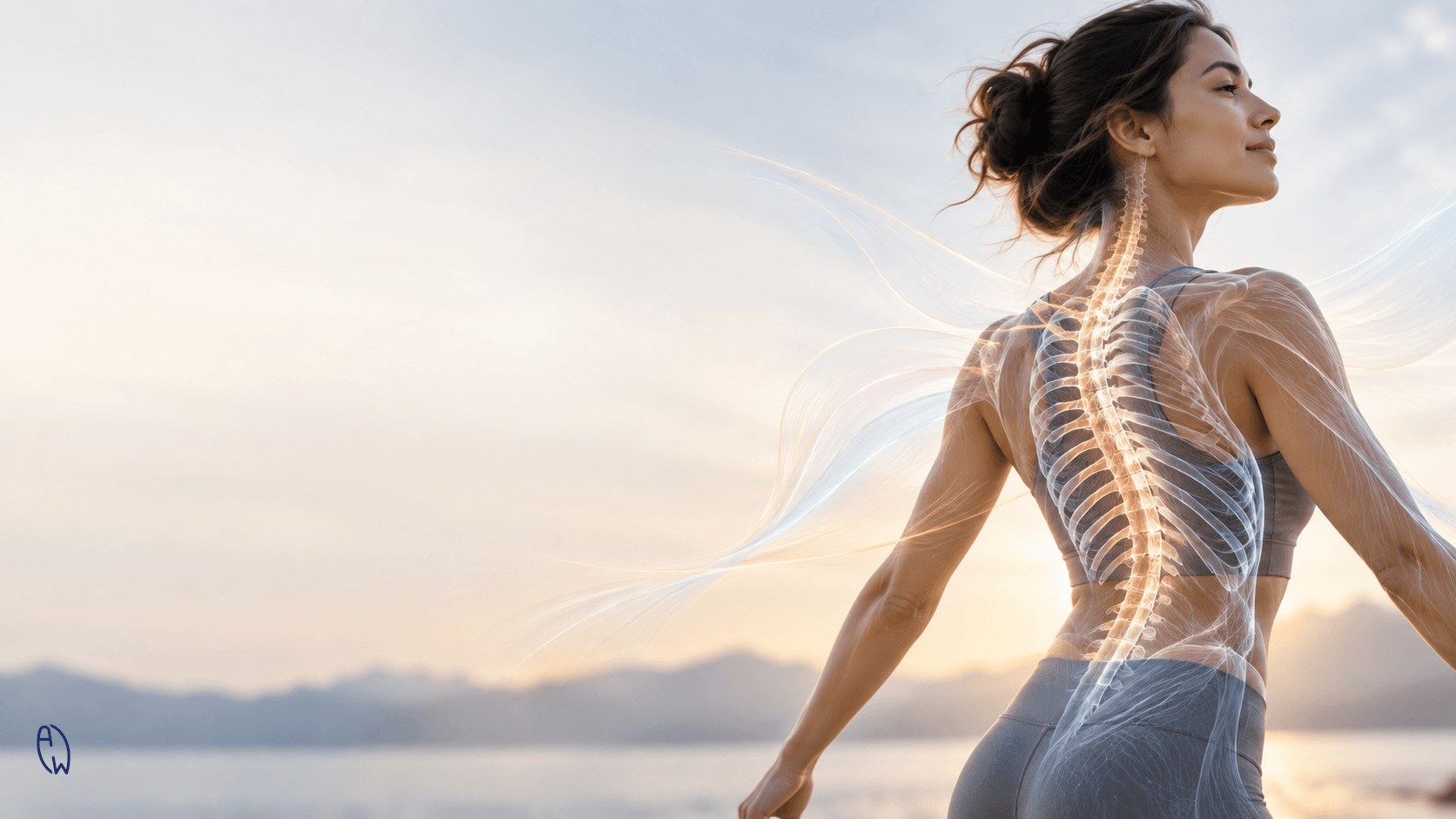
Scoliosis and the Nervous System: Why Your Spine Is More Than a Curve
When people hear the word scoliosis, they often think about one thing: the curve of the spine.
An X-ray shows the curve. The Cobb angle measures it. Then the questions usually begin:
Is my curve getting worse? Can I straighten my spine? Will I eventually need surgery?
These are important questions.
But they are not the only questions that matter.
Because the spine does not exist in isolation.
Scoliosis is a structural condition of the spine, but living and moving with scoliosis involves the whole body. How you breathe, balance, move, load your body and respond to pain can all influence your physical experience.
Your nervous system plays an important role in coordinating movement and responding to pain and perceived threat. Your muscles and connective tissues work together to support movement. And your confidence—or fear—around movement can influence how freely you use your body.
This does not mean that stress causes scoliosis.
It does not mean scoliosis is “all in your head.”
And it does not mean fascia work or nervous-system exercises can magically straighten a structural spinal curve.
It means there is a bigger story to scoliosis care than the shape of the spine alone.
After more than 20 years of working with people with scoliosis, there is one thing I hear again and again:
“I don't just want a straighter spine. I want my life back.”
Is Scoliosis Only a Problem With the Spine?
Scoliosis is a three-dimensional spinal deformity involving changes in spinal alignment and rotation.
But the way a person functions with scoliosis is influenced by much more than the curve itself.
Your body constantly receives information from your joints, muscles, skin, eyes and inner ear. Your nervous system processes that information and coordinates how you move and respond.
When someone has pain—or becomes worried that a particular movement might damage their spine—they may gradually change the way they move.
They may:
-
Brace their muscles more than necessary
-
Take smaller movements
-
Avoid bending
-
Avoid rotation
-
Stop lifting
-
Change their breathing
-
Reduce physical activity
-
Become highly aware of every sensation in their back
-
Lose confidence in what their body can safely do
Over time, these protective strategies can become familiar.
The important distinction is:
The nervous system can influence how you move with scoliosis without being the cause of the structural curve itself.
That distinction matters.
Your scoliosis is real.
Your pain is real.
Your fear can be real.
And your capacity to change how you move can also be real.
When Feeling Unsafe Changes the Way You Move
Your nervous system is designed to protect you.
When your brain perceives a threat, your body can respond by changing muscle activity, breathing, attention and movement.
Pain can contribute to this.
So can fear.
Imagine being told repeatedly:
“Be careful with your back.”
“Don't lift too much.”
“Don't twist.”
“Don't bend.”
“You have scoliosis, so you need to protect your spine.”
The intention may be to keep you safe.
But after hearing these messages for years, some people begin to develop a very different relationship with movement.
They start asking:
Is this safe?
Did I twist too far?
Am I making my curve worse?
Should I stop?
Movement becomes something to monitor rather than something to enjoy.
This can contribute to fear of movement and hypervigilance—a heightened focus on bodily sensations and possible threats.
That does not mean the person is imagining their symptoms.
It means the brain and body are involved in the experience of pain and movement.
And when someone has spent years protecting their spine, one of the most important parts of rehabilitation may be helping them discover:
“My body can do more than I thought.”
Scoliosis and Breathing: Why the Rib Cage Matters
Breathing is often overlooked when we talk about scoliosis.
But breathing is movement.
Every breath involves coordinated movement of the diaphragm, rib cage and trunk.
Depending on the location and severity of a spinal curve, scoliosis can affect the shape and mechanics of the thoracic cage and, in more significant cases, respiratory function. SOSORT guidelines specifically recognize respiratory function as an aspect that may need assessment and exercise-based attention in appropriate patients.
At the same time, breathing is also influenced by stress and perceived threat.
When people feel anxious or guarded, breathing may become faster, shallower or more restricted.
This is why breathing can be an important part of a broader movement assessment.
The question isn't simply:
“Can this person breathe normally?”
It can also be:
“How does this person breathe while they move?”
Scoliosis-specific exercise approaches may incorporate breathing strategies, and research suggests exercise-based interventions can influence respiratory function in some people with scoliosis. A 2026 systematic review and meta-analysis found improvements in respiratory function alongside other outcomes in exercise-based interventions, although the evidence and effects vary between approaches and populations.
But we should be careful.
Breathing exercises are not a cure for scoliosis.
Their role is to support respiratory function, movement, body awareness and physical capacity where appropriate.
What Does Fascia Have to Do With Scoliosis?
Fascia is connective tissue that surrounds and connects structures throughout the body.
It is part of the body's movement system, but it is important not to oversimplify its role.
Fascia is not a piece of tissue that simply “pulls” the spine into alignment.
And there is no reason to promise someone that releasing fascia will straighten their scoliosis.
Instead, fascia can be understood as one component of a larger system involving:
-
Muscles
-
Joints
-
Connective tissues
-
The nervous system
-
Breathing
-
Movement
-
Load
When you move, these systems interact.
This may help explain why someone with scoliosis can experience tension, stiffness or movement restrictions in areas that are not immediately next to the spinal curve.
But interconnected does not mean that every symptom has one simple cause.
Good scoliosis care requires looking at the individual rather than blaming one tissue or one system.
Scoliosis Is a Whole-Body Movement Pattern
The spine connects with the pelvis.
The pelvis connects with the hips.
The ribs connect to the thoracic spine.
The feet interact with the ground.
Your breathing influences the movement of your trunk.
Your nervous system coordinates all of it.
So while scoliosis is a spinal condition, living with scoliosis is a whole-body experience.
Two people can have a similar Cobb angle and completely different experiences of pain, strength, mobility and confidence.
One person may lift weights, travel, run and dance without thinking much about their spine.
Another may avoid bending, rotation and lifting because they are afraid of making their scoliosis worse.
Same curve. Very different person.
This is why the X-ray matters—but it cannot tell the entire story.
The X-Ray Is Important. But It Isn't the Whole Story.
The Cobb angle is an important measurement in scoliosis assessment and is widely used to quantify spinal curvature.
If you want to understand what your Cobb angle actually means, see our detailed guide:
Cobb Angle in Scoliosis: Measurement, Severity & Treatment.
But an X-ray cannot tell us everything about how someone functions.
It cannot show:
-
How strong you are
-
How confidently you lift
-
How well you control movement
-
How freely you rotate
-
How you breathe during exercise
-
How much you fear movement
-
How your body responds to physical load
-
Whether you can travel comfortably
-
Whether you can run or dance
-
How scoliosis affects your quality of life
This is particularly important in adults.
Quality of life is an established outcome of interest in adult scoliosis research, and validated patient-reported measures such as the SRS-22 and Oswestry Disability Index are used to assess how scoliosis affects people's lives.
So progress should not automatically be defined by whether an X-ray looks dramatically different.
A person can have meaningful improvements in strength, mobility, function and quality of life without a dramatic change in spinal alignment.
Should People With Scoliosis Lift Weights?
This is one of the questions I hear most often.
And it is especially important for women who have spent years being told that lifting or loading their spine is dangerous.
The answer is not simply:
“Never lift.”
Exercise should be individualized according to the person's age, curve characteristics, symptoms, physical capacity, goals and medical circumstances.
But having scoliosis does not automatically mean you should stop becoming stronger.
Strength matters throughout life.
Maintaining muscle mass, physical capacity, balance and independence becomes increasingly important as we age.
And if you already live with scoliosis, maintaining your physical capacity may give you a larger physical reserve to draw on as life changes.
The better question is not:
“Should I ever load my spine?”
It is:
“How can I learn to tolerate and control load appropriately?”
That is a very different conversation.
Our guide to exercise with scoliosis as an adult goes deeper into resistance training, running, swimming, Pilates, yoga and scoliosis-specific exercise.
Strength Without Losing Flexibility
I don't believe strength and flexibility have to be opposites.
You can become stronger while maintaining mobility.
You can learn to stabilize without becoming rigid.
You can develop control without eliminating movement.
You can learn to lift while still being able to bend.
You can build strength while continuing to rotate.
The goal isn't to turn the body into a rigid structure that is afraid of movement.
The goal is capacity.
Capacity to move.
Capacity to load.
Capacity to adapt.
Capacity to recover.
And capacity to trust your body again.
Research on exercise for scoliosis is still evolving. A systematic review of stabilization exercise in adults with scoliosis found that evidence was limited, highlighting the need for better-quality research.
More recent evidence is encouraging: a 2026 systematic review and meta-analysis found that exercise-based interventions may improve spinal curvature, respiratory function and quality of life in people with idiopathic scoliosis, although study quality, populations and interventions varied.
That is the right way to discuss exercise:
Promising, useful and individualized—not a guaranteed cure.
Freedom of Movement Is a Meaningful Treatment Goal
For many people with scoliosis, success isn't simply about changing the appearance of the spine.
It might mean being able to:
-
Bend forward without fear
-
Pick something up from the floor
-
Rotate comfortably
-
Stretch before and after exercise
-
Carry luggage through an airport
-
Lift weights
-
Go hiking
-
Run
-
Dance
-
Play with their children
-
Travel
-
Exercise without constantly thinking about their back
These may sound like ordinary activities.
But if you've spent years being told to protect your spine, freedom of movement can feel extraordinary.
This is why our approach at All Well emphasizes the relationship between posture, movement and function—not simply appearance. Our article on posture correction for scoliosis explores this idea in more detail.
What If My Scoliosis Doesn't Get Straighter?
This is an important question.
Sometimes people assume that if their spinal curve doesn't decrease, treatment has failed.
But what if you become stronger?
What if your balance improves?
What if you can lift something you couldn't lift before?
What if you can rotate more comfortably?
What if you stop being afraid of bending?
What if you return to running?
What if you travel without constantly worrying about your back?
What if your pain becomes more manageable?
Those are meaningful changes.
For adults with scoliosis, exercise research remains less extensive than we would like, but existing evidence suggests that exercise-based rehabilitation can have benefits for pain, function and quality of life in some people.
So the question should not always be:
“Did the curve disappear?”
It should also be:
“What can this person do now that they couldn't do before?”
Can Scoliosis Get Worse With Age?
This is another reason strength and long-term physical capacity matter.
Adult scoliosis can progress, but getting older does not automatically mean that every curve will worsen.
Progression depends on factors including age, curve magnitude and pattern, skeletal maturity, spinal degeneration and other individual factors.
You can read more about this in our article:
Can Scoliosis Get Worse With Age? What Really Determines Spinal Progression.
The important point is that long-term scoliosis care should not begin and end with monitoring the curve.
It should also consider:
How strong are you?
How mobile are you?
How well do you move?
How much physical capacity do you have?
What activities do you want to continue doing as you age?
Does a Straighter Spine Always Mean a Better Outcome?
This is where we need a more nuanced conversation about scoliosis surgery.
Spinal fusion can be an appropriate and life-changing treatment for some people.
It can reduce deformity and may be recommended when the potential benefits outweigh the risks.
This article is not an argument against spinal fusion.
It is an argument against assuming that spinal alignment is the only measure of success.
A straighter spine can be a meaningful outcome.
But it is not the same thing as saying that every other aspect of someone's physical life has automatically been solved.
Surgery changes spinal structure.
Rehabilitation addresses function.
These are different, but complementary, considerations.
Someone who undergoes fusion may still need rehabilitation to develop strength, movement strategies and confidence.
Someone who does not require surgery may benefit from a structured conservative approach.
The appropriate decision depends on the individual and should be made with appropriately qualified healthcare professionals.
Non-Surgical Scoliosis Treatment: What Are We Actually Trying to Achieve?
When I focus on non-surgical, non-invasive scoliosis care, I am not promising that every curve can be straightened.
I don't want to give people false hope.
I want people to understand that there may be options between simply watching the curve and undergoing major surgery, depending on the individual situation.
Conservative care may include:
-
Scoliosis-specific exercise
-
Strength and conditioning
-
Movement retraining
-
Mobility work
-
Postural awareness
-
Breathing strategies
-
Balance and coordination
-
Load tolerance
-
Pain management
-
Education
-
Building confidence with movement
The evidence for these approaches is not identical across all ages and types of scoliosis.
For adolescents with idiopathic scoliosis, international guidelines support individualized physiotherapeutic scoliosis-specific exercise as part of conservative management, with programs tailored to curve pattern and treatment phase.
For adults, the evidence base is more limited and treatment goals are often more focused on symptoms, function, physical capacity and quality of life.
That distinction matters.
Good healthcare does not promise what the evidence cannot support.
What I Have Learned From More Than 20 Years of Working With Scoliosis
After more than 20 years of working with people with scoliosis, I've learned that many patients are not asking for perfection.
They're asking for freedom.
They don't necessarily want to spend years focusing on their spine just to achieve a straighter X-ray.
They want to lift.
They want to travel.
They want to run.
They want to dance.
They want to exercise.
They want to bend.
They want to stretch.
They want to play.
They want to stop thinking about their back every day.
That changes how I think about scoliosis care.
The question isn't only:
“How can we change the curve?”
It is also:
“How can we help this person use their body with greater strength, control and confidence?”
The Goal Isn't Just a Straighter Spine
A straighter spine may be an appropriate and meaningful goal for some people.
But it should not automatically be the only goal.
Because your body is more than an X-ray.
Your life is more than a Cobb angle.
And your success with scoliosis should not be defined entirely by how straight your spine looks.
The goal can also be:
Strength without unnecessary fear.
Mobility without unnecessary restriction.
Control without rigidity.
Movement without constant hypervigilance.
Exercise without constantly worrying about your spine.
And ultimately:
the freedom to live your life without scoliosis occupying every thought.
You don't have to ignore your scoliosis.
You don't have to pretend your curve isn't real.
And you don't have to believe that every movement will make it worse.
Instead, the aim is to understand your body, respect its limitations, progressively build its capacity and make decisions based on your individual needs.
Because perhaps the most important question isn't:
“How straight is my spine?”
It is:
“What can my body do now that I was once afraid to do?”
Frequently Asked Questions About Scoliosis and the Nervous System
Can scoliosis affect the nervous system?
Scoliosis is a structural spinal condition, but living with scoliosis can affect movement, pain, body awareness and confidence. The nervous system also plays an important role in coordinating movement and processing pain and perceived threat. New neurological symptoms should always be medically assessed.
Can stress make scoliosis worse?
Stress does not simply cause a structural scoliosis curve. However, stress can influence muscle tension, breathing, pain sensitivity and movement behaviour. For someone already living with scoliosis, these changes may affect how their body feels and moves.
Can scoliosis affect breathing?
Yes, particularly with more significant thoracic curves. Scoliosis can alter the mechanics of the rib cage and trunk, and some people may experience respiratory limitations. Appropriate respiratory assessment and exercise may be useful when indicated.
Should you avoid lifting weights if you have scoliosis?
Not automatically. Exercise should be individualized, but scoliosis does not automatically mean a person should avoid resistance training. The appropriate exercises, intensity and progression depend on the person's condition, symptoms, experience and goals.
Can exercise straighten scoliosis?
Exercise should not be marketed as a guaranteed way to straighten a structural spinal curve. However, recent systematic-review evidence suggests exercise-based interventions may improve some outcomes—including quality of life and, in some populations, spinal curvature—although evidence quality and results vary.
Is spinal fusion the only treatment for scoliosis?
No. Depending on the individual's age, curve, symptoms and risk of progression, scoliosis management may include observation, exercise-based rehabilitation, bracing in appropriate patients or surgery.
Can scoliosis pain change even if the curve stays the same?
Yes. Spinal structure and symptoms do not always change in parallel. Pain, strength, physical conditioning, movement patterns and quality of life can change even when spinal alignment remains relatively stable.
What should scoliosis treatment focus on?
A comprehensive approach should consider the spinal curve alongside symptoms, movement, strength, mobility, physical capacity, psychological factors, functional goals and quality of life.
A Final Word From All Well Scoliosis Centre
At All Well Scoliosis Centre, our approach to scoliosis is not based on promising a perfect spine.
It is about understanding the individual behind the X-ray.
We believe scoliosis care should consider structure, movement, strength, mobility, breathing, confidence and quality of life—and that treatment should be individualized rather than based on a one-size-fits-all formula.
If you are considering non-surgical scoliosis care, speak with a qualified healthcare professional who can assess your individual condition and help determine what approach is appropriate for you.
Your spine is part of you.
It is not the whole of you.